Wednesday, January 31, 2018

Don's Blog Sailing by Kugluktuk

After our tundra walk in the flowers at  the mouth of the Nakyoktok River we went west in the Coronation Gulf
sailing by Kugluktuk (lower left on map)which is in western Nunavut  near the border of the Northwest Territory. I was disappointed that we did not stop. It was here in 2000 that I canoed the Coppermine River with my son Lee ending up at the hamlet which until 1996 was called Coppermine. During the trip we saw green deposits of copper along the shore. Its current name,Kugluktuk, means place of the moving water.


The river has a rich history. British explorer Samuel Hearne led by Chipewyan guide Motanobee descended the Coppermine River  reaching its mouth  at the Coronation Gulf in 1771. John Franklin reached the mouth of the river on his land expedition of 1819 to 1822. It was on the way home after this that Franklin became known as the 'man who ate his boots' and some of his men became known for eating each other. 

Canoeing the Coppermine River is an extraordinary challenge. It has many named difficult rapids. Here I am atop a cliff overlooking Rocky Defile, the most dangerous of the rapids, which we portaged around.


This is a photo of Escape Rapids (internet image) which Lee and I ran in our covered canoe. It is the singularly most exciting set of rapids in my canoeing experience. At one point we had to go over a large standing wave to bypass a huge boulder. Our canoe rose up and then I remember screaming with excitement as we  torpedoed down into the wave with a full frontal dive into the cold water and then we broke free.


This is Bloody Falls, the last rapid and falls on the river (internet image). It got its name because Samuel Hearne's guide, Matonobee and his band of Indians massacred a band of sleeping Inuit here in 1771. It was a definite portage for us. 


Below Bloody Falls is the hamlet of Kugluktuk(internet image) on the Coronation Gulf of the Arctic Ocean.


At the time of our trip in 1994 we were fortunate to meet Peter Irnik, who was then the Premier of Nunavut. He was in town to celebrate the journey of the docked ship, the St Roch II, which was retracing the route of Henry Larsen's St Roch I. Remember Larsen's Sound where we met the Icebreaker? These Inuit are talented carvers. This is an igloo that I obtained from a local artist.


The top of the igloo comes off revealing this detailed tableau.

I had the opportunity to visit with the nurse at the town health facility. If she had questions about patients she could radio for answers and said she often did. I asked her what were the major health issues that she dealt with. She said that this included: alcoholism and drug abuse, spousal assault and sexual abuse, and suicide mostly in children. I asked her how they did it and she said they overdosed on tylenol.

Tuesday, January 30, 2018

Don's Blog Nakyoktok River III Flowers II

The few flowers that we saw were exquisite. This is Mouse-ear Chickweed (Cerastium vulgatum)which is an herbaceous perennial with showy white starlike flowers with five notched petals. It is distinct because of the rounded tips of the petals and the hairy leaves which resemble mouse ears.


This is another saxifrage or rock breaker. Being a water storing succulent aids its survival. 


This is Arctic Bell Heather (Cassiope tetragonal). It is also known as arctic white heather and white arctic mountain heather. The corolla is white  and bell shaped with fused 5-lobed sepals and 10 stamens.The leaves are opposite and overlap close to the stem. The leaves overwinter.


  • Our photographer mentors had suggested the value of getting close to the subject so I got on my stomach to photograph the arctic bell heather. During this micro exploratory move I found that I was in the middle of a large patch of blue berries which I had completely missed. There is nothing like the thrill of discovery.


    Monday, January 29, 2018

    Don's Blog Nakyoktok River II Flowers I

    We are traversing the Northwest Passage late in the summer and most of the many arctic flowers have bloomed long before our arrival . As expected we did see some late bloomers.
    These are all tundra flowers and most were at the mouth of the Nakyoktok River.


    The most spectacular flower and the most common one during our stay was Lapland Rosebay (Rhododendron 
    lapponicum). It has showy upward facing flowers, This rhododendron has larger blossoms and more stamen than the arctic azalea.


    This is a Saxifrage (Saxifraga). It is an arctic perennial also known as rock foil. The leaves grow close to the ground. The plants thrive on rocky soil in the harsh arctic with a tough root system and penetrating taproots. 

    The flowers have 5 petals and are bisexual (Hermaphroditic). What is a good blog without a little sex.


    Draba nivalis is also known as Snow Whitlow Grass. A member of the mustard family, this plant is a perennial herb which branches into clustered rosettes forming small dense tussocks.The flower stem is covered with small stellate hairs. Each stem may have 5-10 flowers.


    Mountain Aven is also called Dryas octapetala. In Rocky Mountain National Park it is called Alpine Aven. It is a small evergreen shrub that forms large colonies.


    The flower, as you might guess, has eight petals.


    The mountain aven is the official flower of the Northwest Territories. It is historically important to the Inuit.  The twisting of seed head marked the time of the year to move inland to hunt caribou.


    Sunday, January 28, 2018

    Don's Blog Taking a Break at the Sculpture Park

    I had to take a trip blog break. The day was sunny and beautiful.  Laumeier Sculpture Park is my all time favorite. The always get new exhibits and move the old favorites around creating adventure.
    An old favorite.

    I have always loved this walnut tree.


    Can you picture the animal that laid this?


    Brand new  "DEER". Spectacular in fiberglass.

    A Sunday luncheon adventure

    After a walk at Laumeier Sculpture Park we went to the St Louis Bread Co. Jan with her dietary issues with gluten brought her own sandwich. I went inside to oder. The girl at the cash register could not have been nicer. I ordered a turkey sandwich. a piece of bread, and a lemonade. I paid with my credit card and gave her a $2 tip because she was so pleasant. The machine told me to remove my card but the transaction did not take. She told me I had taken my card out too soon. So we did it again but now without a tip. She told me the order would be delivered to my table. We got a table outside. The dinger went off so I went inside to the place where we used to pick up our order. A friendly food deliverer said he would deliver my food to our table outside. I went back outside. The order was delivered and instead of one turkey sandwich there were two turkey sandwiches. I checked my receipt. I had ordered one turkey sandwich and had paid for one turkey sandwich. The extra bread was there also. And my lemonade which I had picked up previously. Jan had been eating her ham sandwich on gluten free bread. 
    A huge engined car drove up as we started to eat and started idling loudly in my head. My signal to turn it off was to no avail so we moved. Jan took her sandwich to the car and I finished one of my two turkey sandwiches
    inside. As usual it was really good. After I finished my one turkey sandwich I decided that if I gave the other turkey sandwich back they would have to dispose of it so I decided to dispose of  it in one of their take home boxes. I went to the nice delivery person who had to go behind the counter for the box. I transferred the remaining turkey sandwich to the box and pressed the extra piece of bread down flatter so it would fit. I still also had my now covered lemonade plastic cup. I attempted to close the take home box to no avail. I had to pick up my lemonade and the open box as someone put all their trash into the nearby receptacle missing my open sandwich box by 2 mm. Because of necessity I had to take my open box and my lemonade to the Men's Room. There is not really any flat surface in the Men's Room to put down a lemonade and an open box. I will leave it to your imagination to figure how I handled this quandary in a sanitary manner. It did not work out perfectly. I will leave that to your imagination also. I took the lemonade and the open box to an empty table. I could not close the box. There were no instructions. I needed an engineer. I picked up my lemonade and my open box and took it back to the VERY nice food delivery person for help in closing the box. After trying to close the box he VERY nicely admitted that he could not close the box. He turned to the other nice food delivery person who admitted up front that he did not know how to close the box. They both VERY nicely looked across the high counter to another really nice person who said, "No one knows how to close those boxes." She came around the counter and showed us the very intricate manner needed to close the box with three paper tabs. She said,"Be careful. Those boxes come open. They don't stay closed." I told her I knew someone in management who might be able to address the issue. Her eyes lit up. "Great," she said,"Great!" I checked the sandwich but unfortunately it was already dry. Don't worry. I'll eat it tomorrow.
    Waste not,Want not.
    Now if you can help me find my car that would really help.

    Saturday, January 27, 2018

    Don's Blog North to Victoria Island - The Nakyoktok River I

    After Baillie Bay we sailed north to southern coast of Victoria Island across Coronation Gulf.

    We anchored in Johanson Bay at the mouth of the Nakyoktok River, site of an abandoned DEW line station. 


    The river basin offers an exceptional tundra area to hike and explore. 


     What looked like a starkly desolate area offered a trove of tundra treasures.


    This area is a fertile hunting site with resultant bones including this caribou. 


    There were also multiple long bones and even a small mandible. 


    Friday, January 26, 2018

    Don's Blog Back to the Passage - Heading West


    Leaving Gjoa Haven we followed the path of Amundsen through the Simpson Strait. This is the passage between the Adelaide Peninsula on the Canadian mainland and King William Island. 


     The Simpson Strait is 40 miles long and 2-10 miles wide.


    We traversed  the Queen Maude Gulf, and circled the northern shore of the  Kent Peninsula which is almost totally surrounded by water. It is separated from the mainland by the Melville sound. To the north is the Dease Strait and Victoria Island. To the west is the Coronation Gulf. The northwest tip is Cape Flinders. About 25 miles from this is Point Turnagain reached by John Franklin from the west on his land exploration of 1821. It is where he turned back to the west.

    Turning south we passed numerous rocky islands going into Bathurst Inlet. We took the Zodiacs ashore on the western side of Baillie Bay of Arctic Sound just below  the mouth of the Hood River.


    We felt we had been in "town" too long and were happy to get our boots on the land. It was pure tundra and pure delight.


    There were fresh tracks on the beach.

    Wolf


    and a new bear -  the Grizzly


    and some others that maybe you could help identify.


    After a delightful aimless walk on a sunny afternoon we headed back.  There is nothing more compelling than the endless tundra of the high arctic stretching to the sea.


    Thursday, January 25, 2018

    Don's Blog Gjoa Haven IV Perspective on Arctic Village Travel II

    My second interview was outside Gjoe Haven's Nattilik Heritage Center by a pleasant young Canadian writer named Elaine Anselmi (below). She worked for the magazine 'uphere' and took down the interview with a short pencil and a yellow lined note pad. She had recently been flown out to the Erebus site with a group of other media people.

    Writer Elaine Anselmi


    Give And Take

    With more people making stops in the coastal communities of Canada's Arctic, what do cruise ship passengers and locals hope to get out of the experience?
    By Elaine Anselmi
    Dec 18
    2017
    From the December 2017 Issue
    When the cruise ship Hanseatic drops anchor, a crew of six docking a sailboat in Cambridge Bay, Nunavut, pick up their pace. Cruise ships mean long line-ups and the sailors need to get to the store quickly for supplies.
    Already this summer, they had passed dozens of other personal vessels like theirs in the Northwest Passage, as well as larger cruise and expedition ships. Most of the crew had been on the water for five months since leaving Maryland. They'd stopped in Greenland, been blocked in by ice near King William Island and nearly ran aground following a narrow line through solid ice.
    Passengers of the Hanseatic come to shore. Photo by Elaine AnselmiPassengers of the Hanseatic come to shore. Photo by Elaine Anselmi
    They'll set sail again in just a few hours, though some aboard say they wish they could stick around to see more of the town. This is, after all, a pleasure cruise through the Northwest Passage. But it has been a bad year for ice and their window at the end of August is quickly closing. And so is their shot at beating the crowd.
    As the crew tie off the sailboat, zodiacs loaded with Hanseatic passengers, dressed in matching bright red jackets and rubber boots, pull to shore. At least the sailors missed the 1,500-person Crystal Serenity, which came and went earlier that week.
    Hanseatic staff help their guests scramble onto land, where they shake hands with guides waiting to introduce them to Cambridge Bay. More than 50 people were hired by the hamlet that day to make chowder, bannock, boiled fish and tea, to perform a drumdance, to model in a fashion show and act as interpreters around town.
    Passengers aboard the 200-passenger Hanseatic, and another 150-passenger ship that came in a few days earlier, the Bremen, are carrying mostly German tourists. Both ships are owned by Hapag-Lloyd and have been stopping in Cambridge Bay for years. More years than Cathryn Epp, the hamlet economic development officer, can recall. It was up to her to pull together the cruise ship hospitality corps.
    "We'll hire someone and we provide the supplies and basically say make bannock for this amount of people and they just go crazy making bannock for us," says Epp. She also rented furs from a local couple for the event. "I went to their house, grabbed most of the furs they have and put them on display because passengers really like to see the furs we have from all the different animals."
    For a ship the size of the Crystal Serenity, there were a few more details to work out. For one, the ship was too large to anchor in the bay, so it anchored in the ocean while passengers were ferried by zodiac to a gravel pit outside town. This provided another job for locals: School bus, taxi and van drivers were hired to bring passengers to the community hall and back. There was a loop running all day, with about 200 passengers in town at any given time. Lots of arts and crafts were sold. It was a good day, says Epp.
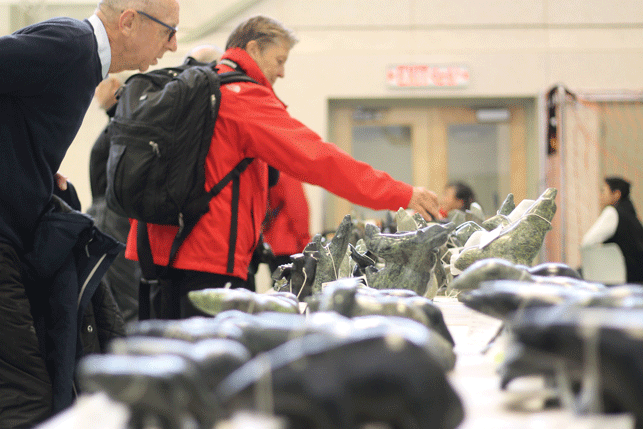
    Passengers shop for carvings. Photo by Elaine AnselmiPassengers shop for carvings. Photo by Elaine Anselmi
    The cruise ship companies will provide the hamlet with money upfront to run activities during their stops. Epp gives them a projected budget. The day after the Hanseatic leaves, Epp will cut cheques to everyone who helped out—including a few people who hadn't signed up to work, but showed up anyway and lent a hand, or a car.
    This boost to the economy is significant, says Epp—"especially this year and last year because of Crystal Serenity coming. Small ships contribute as well, but the Crystal Serenity has such a big number of passengers." (In September, Crystal Cruises, which owns the Crystal Serenity, announced it would suspend Northwest Passage trips until 2020, due to shrinking demand.)
    In Gjoa Haven, Nunavut, where Roald Amundsen overwintered twice from 1903 to 1905, the Norwegian explorer's time spent in town is enough to draw tourists. Amundsen is a national hero in Norway and passengers on a Norwegian cruise ship that came in this summer spent more than $10,000 on local arts and crafts at Nattilik Heritage Centre, says manager Martha Porter. Along with Amundsen, Gjoa Haven's senior administrative officer David Stockley says the discovery of the Franklin expedition's ships Erebus and Terror is attracting visitors. Gjoa Haven is the closest community to the wrecks and arguably the nexus of Inuit knowledge around the doomed expedition. The heritage centre is full of displays dedicated to the explorers. The hamlet puts about a $50-per-head rate on each passenger coming off a cruise ship to pay performers, guides, security guards and caterers.
    From among a crowd moving down a Gjoa Haven street, Don Sessions, a passenger from St. Louis, Missouri introduces himself as a Franklin fanatic. "I'm looking for Louie," he says, referring to Louie Kamookak the local historian whose efforts helped to find Erebus. They're both members of an online community of Franklin followers—Sessions is hoping to meet Kamookak in person.
    The last chapter of the Franklin story remains to be written and that's bringing history buffs to Gjoa Haven. But that's not all. Many tourists are curious to see the pristine Arctic and learn what everyday life is like for the people who live there. It's a place they've often only seen in books or on the big screen. "I've seen enough museums and churches. I wanted nature," a man from Boston tells me. "I was in the Antarctic in February and figured I better come this way while I still can."
    The basement of the Gjoa Haven hamlet office has been converted into a gallery of carvings. Tour groups filter in and out. A woman comes through the door and asks her young Inuk guide where she grew up, what her family is like and how she spends her days. The rest of the group has spread out to look at the art pieces, many carved in town. "What kind of rock is this?" someone asks aloud to no one in particular.
    "It's limestone," a once-wallflower security guard responds, stepping forward with pride. "The quarry is about 60 miles out."
    Cruise ship tourism provides jobs in Arctic towns with low employment, but the season is only a few weeks long and travelling in Arctic waters isn't a breeze. This year, the first cruise ship scheduled to arrive in Cambridge Bay was turned back by ice in Victoria Strait. Still, the relationship has thus far proven symbiotic—locals can make some quick cash, while tourists get a glimpse of a unique lifestyle.
    A drumdance in Cambridge Bay. Photo by Elaine AnselmiA drumdance in Cambridge Bay. Photo by Elaine Anselmi
    In the Cambridge Bay school gym, as tourists sample local foods and take photos of the fashion show, drumdance and throat-singing performances, one visitor films a local woman lifting her young son in and out of her white embroidered amauti. A banal moment to one person is mesmerizing to another.

    Bonus: This article by my new favorite young Canadian writer, Elaine Anselmi, was just published on the internet by uphere magazine. It is an excellent update on the current status of The Erebus archeological adventure. 


    Wednesday, January 24, 2018

    Don's Blog Gjoa Haven III Perspective on Arctic Village Touring I


     I was interviewed by two reporters in Gjoa Haven. Both writers mentioned the interview in their articles. This reporter taped the conversation as we walked around the hamlet. It came out on the internet on InfoNews.ca in mid September of 2017.


    As Franklin's lure brings people north, Gjoa Haven seeks its share of the booty


    Residents walk down the hill to their home in the town of Gjoa Haven, Nunavut, on Friday September 1, 2017.
    Image Credit: THE CANADIAN PRESS/Jason Franson
    September 16, 2017 - 9:00 PM
    GJOA HAVEN, Nunavut - It's cool and cloudy as Don Sessions, wearing a toque and a good, solid jacket, hops off an inflatable boat that has ferried him from his cruise ship to shore.
    The welcoming facilities in Gjoa Haven, Nunavut, are primitive — a stretch of pebbly beach marked off with yellow police tape. Sessions and his fellow tourists will walk up a dusty dirt trail into town to stroll its dusty dirt roads.
    He's having a ball.
    "I'm loving the trip," says Sessions, a self-described Franklin Expedition nut who has travelled from St. Louis to visit the Arctic hamlet near the site of Sir John Franklin's shipwrecks. "When you were a kid, this is what you dreamed about, if you dreamed about the North."
    That's music to Bob Cheetham's ears.
    "It's going to be huge," says Cheetham, Gjoa Haven's economic development officer. "There's a lot of interest on the cruise ships now."
    Sessions' ship, the 166-passenger French-flagged Le Boreal, is one of six that will stop in Gjoa Haven during this year's six-week season — two more ships than last year.
    Adventurous sailors are also coming. Gjoa (pronounced "Joe") Haven's pretty little bay had four yachts moored there at one point in August.
    "They're buying groceries. They're buying supplies. They're buying fuel. They're visiting our heritage facility here where a lot of the carvers have their stuff on exhibit and for sale," Cheetham says.
    Franklin's ships Erebus and Terror set out from England in 1845 with 129 men to search for the Northwest Passage, but they never returned.
    Gjoa is uniquely placed to take advantage of the discovery of the ships. It's the closest community to where both the Erebus and the Terror finally went down.
    It's an economic opportunity in a place that doesn't have many of them and the community is making big plans to capitalize.
    The first-ever Umiyaqtutt (Inuktitut for "Shipwreck") Festival — two weeks of dancing, community feasts and lectures from Parks Canada and Inuit experts — began Sept. 2.
    Then there's an expansion of the local Nattilik Heritage Centre to include Franklin displays, expected to take a large share of the nearly $17 million budgeted by Ottawa in 2016 for conservation, research and presentation of the artifacts.
    Cheetham says new facilities for Gjoa's highly regarded carvers and even tours to the Erebus site are also in the works.
    "It's huge relative to what we had in the past, and it's growing."
    As well as Franklin, Norwegian explorer Roald Amundsen moored his ship here in 1903 and stayed for nearly two years. His ship was named the Gjoa.
    "You have the two British ships that didn't survive and then you have Amundsen who made it through the Northwest Passage and into the Antarctic," says Cheetham. "He did survive because he learned how to live with the people here — learned all the skills, all the clothing, how to stay alive."
    It's not hard to find people with fond family memories of Amundsen in Gjoa Haven.
    "We pass those stories on from generation to generation," says Jimmy Arqviq, whose great-grandfather knew Amundsen.
    Cruise tourists are met by a local guide who shepherds them through a tightly scheduled program of local art, performances and traditional food. The tour costs $50 a head, which goes to pay guides and performers.
    Cheetham says figures on how much tourists spend while in the community are being developed.
    "Average spending has been low in the past off the cruise ships. But a lot of that's about how we haven't had the promotional stuff on the cruise ships in advance to prepare them for what they might be able to purchase here, and that's changing."
    The community is adding infrastructure such as ATM machines to make it easier for visitors to part with their money. Other communities report the average tourist leaves behind $90 on a shore visit.
    Gjoa Haven is remote and expensive to visit. It offers little in the way of amenities — restaurants, for example. But because it's so small, even a little economic activity can go a long way.
    "Baby steps here," says Cheetham. "We're in the early stages of marketing and promotion."
    But just as explorers charted the Northwest Passage little by little, Cheetham says their stories are slowly building an economy in the community at the heart of their adventures.
    "One thing builds on another."
    News from © The Canadian Press, 2017


    Tuesday, January 23, 2018

    Don'd Blog Gjoa Haven II

    The hamlet  was welcoming.  Houses with 2 stories have fire escapes. The snow mobile carcasses are used as parts stores for
    current snow mobiles.


    Like all native villages the fruits of hunting and fishing are on display.


    Arctic char.


    Here is the "Honey Wagon" that cleans out the septic tanks. We needed a service like this when we lived in Anchorage in the 1960's.  Each house is also served by a potable water truck. The  55 gallon drums are coded green band for recycle and orange band for trash.
    Electricity is generated in the villages by diesel electric generators.
    Notice the many street lights on the utility poles to serve in times of the year when darkness reigns.  The lateral lines off the poles are for electricity and cable TV but not phone.


    The people are warm and friendly. How would you like a group of strangers in red coats checking out your town and taking pictures of everything imaginable and more?
    I am a member of an internet group that is interested in John Franklin's explorations (Remembering the Franklin Expedition). I was hoping to meet up with Louie Kamookak, Inuit historian and a member of the group. I was disappointed that Louie was unavailable on the only day I was in town. 


    On the day of our visit we were  fortunate to meet Jonathan Moore, an archeologist for Parks Canada, near the dock.


     Margaret Bertulli, a Naturalist on our trip, told me that he was like a rock star among the searchers for the missing Franklin ships. She said that it was Jonathan who was at the sonar when the Erebus was found in 2014. He was in town today preparing a new diving platform for next year - see background above.
    While talking to him I told him how excited and impatient we were to see what the underwater archeologists would find. He said he understood completely and that they felt the same way.